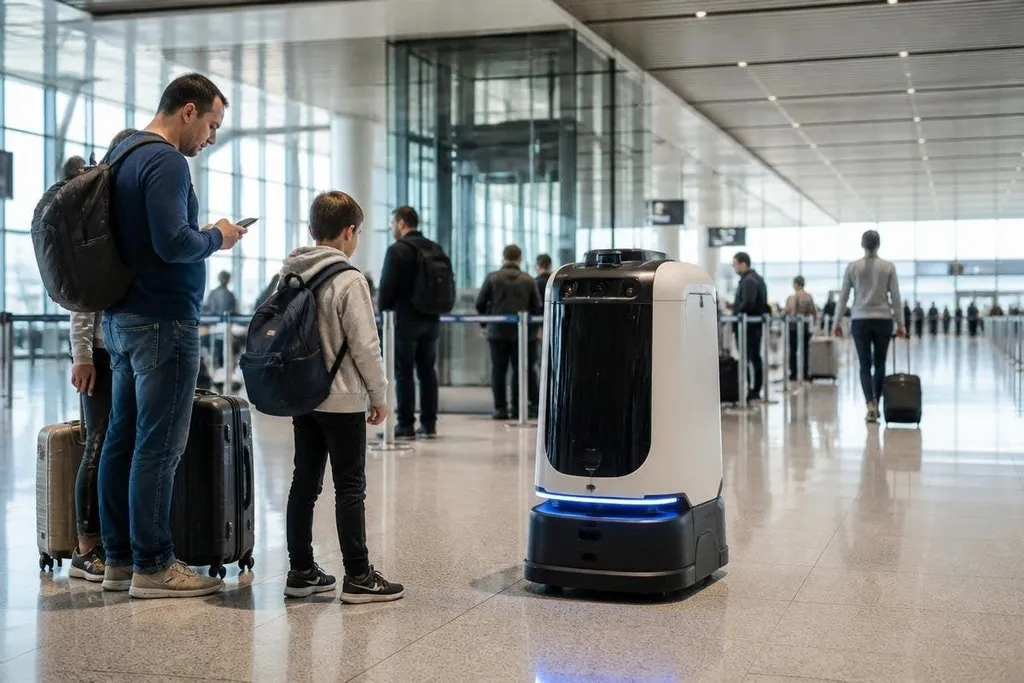
An airport robot has to work around luggage, queues, glass doors, lifts, security rules, and people who may stop without warning. That makes airport automation a test of safe movement and useful service, not a contest to build the most human-looking machine.
- Airport robots need reliable maps, obstacle detection, and safe stopping.
- The hardest tasks often happen at doors, lifts, kerbs, and busy queues.
- A useful airport robot must fit existing staff routines and passenger needs.
The airport is a hard place for a robot
A factory gives a robot a fixed route and a controlled work area. An airport changes by the minute. A gate closes, a cleaning cart blocks a passage, or a family stops in front of the robot while checking a phone.
That setting calls for autonomous navigation, which means the robot must choose a safe path without a person steering every movement. It also needs sensors that can spot people, bags, barriers, and changes in floor space.
A map helps, but the map cannot explain every temporary obstacle. The robot must also share space with other machines. Wheelchairs, service carts, luggage trolleys, and aircraft vehicles may use the same paths. Safe software needs a clear rule for slowing down, waiting, or stopping when the route becomes uncertain.
The jobs worth automating
Airport robots can handle work that is repetitive, location-based, or difficult to staff across long operating hours. Passenger guidance is one example. A robot could point people toward a gate, show a route on a screen, or direct them to a help desk.
That task sounds easy until the robot reaches a junction. A useful guide must know which paths are open, which areas need a boarding pass, and when a gate or security lane has changed. A wrong answer can send a passenger across the terminal with little time left.
Baggage movement is another possible use, but it brings stricter demands. The robot must carry a known load, stop near the correct handoff point, and work around staff who may need to reach the same bag. A small delay repeated across many bags can affect a whole flight operation.
Cleaning, inspection, and delivery work may suit robots better when the route is clear and the task has a fixed result. Even then, the airport needs a way to remove a robot from service when a sensor fails or a passage closes.
A closed concourse can turn an airport robot trial into a service problem. A report on Robot 24 can put the airport, task, trial date, and staff response beside the machine’s claims. I’d judge the system by that record, then look at the parts that decide if it keeps working.
The parts that decide if it works
A robot can move well in a quiet terminal and still fail during the busiest hour. Airport buyers should ask for results from crowded routes, changing maps, blocked doors, and missed handoffs rather than watching a polished demonstration.
Battery life matters because a robot that stops to charge during a busy period may need a staff member to take over. The buyer also needs the charging time, replacement battery cost, network needs, and time required for daily checks.
Human control remains part of the design. A remote operator may need to check a camera view, approve a route, or guide the robot past an unusual obstacle. That person needs a clear alert and a way to stop the machine without searching through several software screens.
Privacy brings another limit. Cameras and microphones can help a robot understand its surroundings, but an airport must decide what data it records, how long it keeps that data, and who can access it. A useful machine with unclear data rules may create work for legal and security teams.
A buying checklist for airport operators
Before a trial moves into a live terminal, check these points:
- Name the task: Set one result, such as gate guidance or cart delivery, and measure it.
- Test busy routes: Include queues, blocked paths, lifts, doors, and sudden stops.
- Set handoff rules: Decide when staff take control and who responds to an alert.
- Price the full service: Count charging, software, repairs, network support, and staff time.
- Check passenger data: Record what the robot collects and set a deletion schedule.
- Define failure: Pause the trial if the robot misses safety stops or sends people the wrong way.
These checks turn a robot trial into an operations test. They also give airport managers a way to compare a robot with a staffed process, which may still work better for tasks that change often.
The better airport robot will be the one that stops safely, asks for help at the right moment, and completes a narrow job without adding work for staff. Until vendors publish results from busy terminals, buyers should fund measured trials rather than buy a promise.